Many people use these terms interchangeably, but they solve different problems.
- A budget app helps you plan where money should go.
- An expense tracker helps you see where money already went.
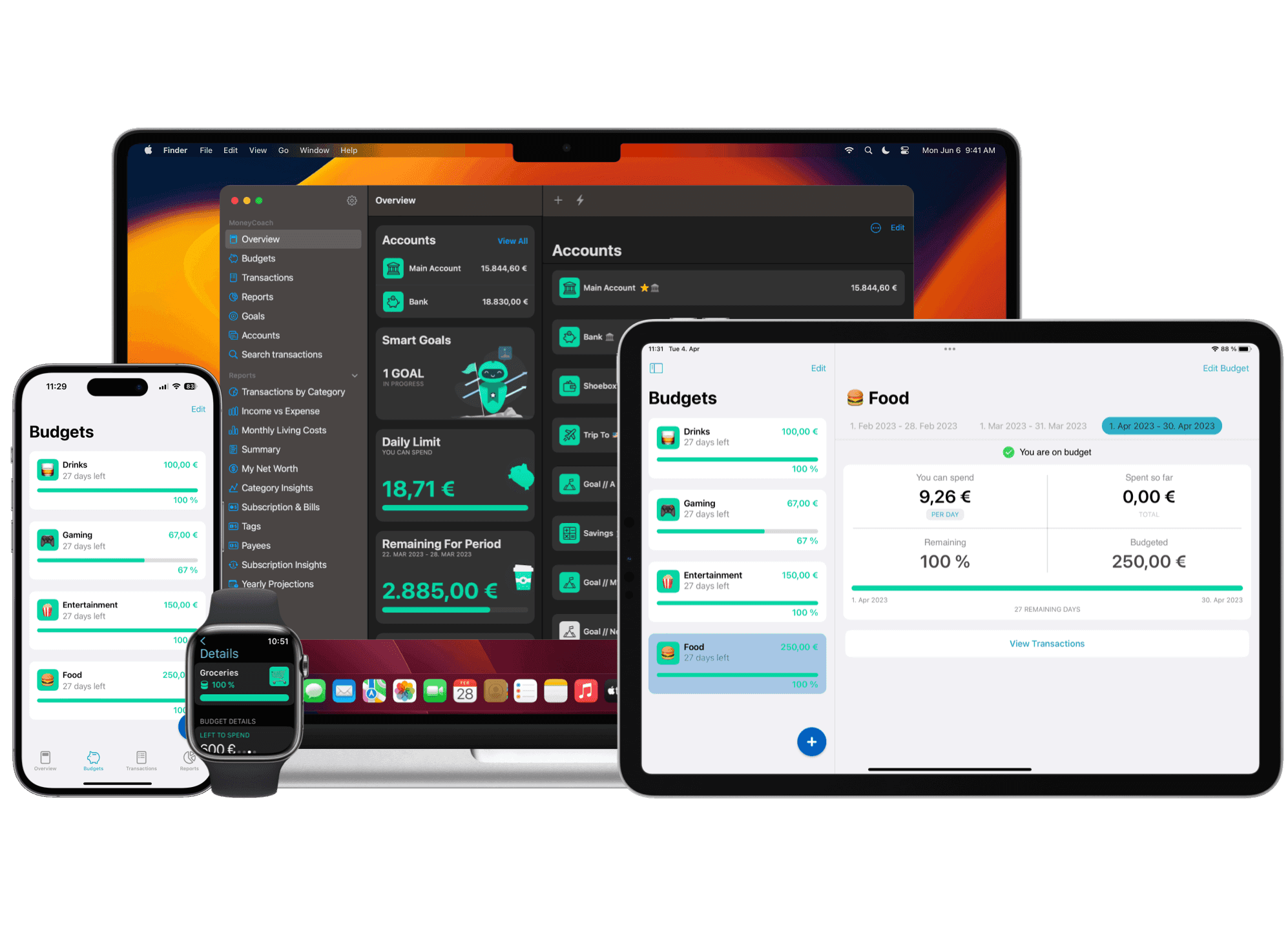
MoneyCoach can cover both jobs. Use the Best Budgeting App for iPhone page if you want planning first, the Best Spending Tracker App for iPhone page if you want visibility first, or the Manual Expense Tracker for iPhone page if you want to start without bank sync. If you want category suggestions and natural-language search, see the AI budgeting app page.
Tracking provides visibility; budgeting provides a plan. Combining them lets you compare intention with actual spending, but the right starting point depends on the problem you are solving.
Use a monthly budget planner app workflow when you want those planned amounts and daily transactions to work together.
Budget app vs expense tracker in one sentence
A budget app is for control before spending. An expense tracker is for clarity after spending.
For a full budgeting foundation, read The Ultimate Guide to Using a Budget Planner Effectively.
Core differences
| Function | Budget app | Expense tracker |
|---|---|---|
| Primary job | Plan and enforce spending limits | Record and categorize transactions |
| Timing | Before and during the month | During and after the month |
| Goal support | Strong (targets, limits, alerts) | Moderate (trend awareness) |
| Feedback | Plan compared with actuals | Actual spending patterns |
| Planning depth | High | Low to medium |
What each tool is best for
Budget app is best when you need:
- Monthly category caps (groceries, dining, transport).
- Shared budgeting with partner/family.
- Debt payoff planning and timelines.
- Goal-based budgeting with reminders.
If debt is part of your plan, use a dedicated payoff model alongside your budget: the Debt Payoff Calculator for several debts, or the Credit Card Payoff Calculator for one card.
Expense tracker is best when you need:
- A fast way to stop "where did my money go" confusion.
- A baseline view of spending patterns.
- A low-friction first habit before full budgeting.
One progression you can test
If you have no reliable spending record, try this sequence:
- Track all spending for 30 days.
- Identify top 3 categories driving overspend.
- Set category caps and monthly targets.
- Review weekly and adjust early.
That shift moves you from passive logging to active money management.
Signs you've outgrown a simple expense tracker
- You keep overspending in the same categories.
- You want monthly spending limits but cannot enforce them.
- You need scenario planning for future goals.
- You are preparing for larger commitments (home, family, retirement).
At that point, move to a budgeting workflow and add planning tools from the Free Tools hub, especially the Retirement Calculator for long-range decisions.
Worked example: tracking versus planning
Suppose the last 30 days show $620 of groceries, $240 of dining, and $95 of subscriptions.
An expense-tracking review can answer which merchants created the total, whether any transaction was duplicated, and which subscriptions were actually used. A budgeting review adds the next decision. If reliable income and essential costs support $800 for those categories next month, the plan could look like this:
| Category | Last month | Next plan | Decision |
|---|---|---|---|
| Groceries | $620 | $560 | Plan meals and review weekly |
| Dining | $240 | $180 | Choose two planned outings |
| Subscriptions | $95 | $60 | Cancel or rotate low-use services |
| Total | $955 | $800 | Redirect $155 deliberately |
This is an example, not a recommended allowance. The tracker supplies the baseline; the budget records the choice. During the next month, actual transactions show whether the estimate was realistic.
Quick decision guide
Choose an expense tracker first if:
- You are not currently tracking anything.
- You need a simple habit with minimal complexity.
Choose a budget app now if:
- You already track spending but still miss targets.
- You want proactive limits and goal-based planning.
- You need stronger structure and accountability.
Final takeaway
Expense tracking tells you what happened. Budgeting changes what happens next.
If your goal is record keeping, a focused tracker may be enough. If your goal is to direct future spending, choose a workflow that combines a plan, transaction tracking, and regular review.