To download an Apple Card statement on iPhone, open Wallet, tap Apple Card, tap Card Balance, scroll to Statements, and choose a month. Tap Download PDF Statement for the official document or Export Transactions when you need data for a spreadsheet or budgeting app.
Apple also supports statement access on iPad and at card.apple.com. In May 2026, Apple added the ability to export transactions for a custom date range, so you are no longer limited to one completed statement month. These steps are based on Apple's current Apple Card export instructions, last checked September 18, 2026.
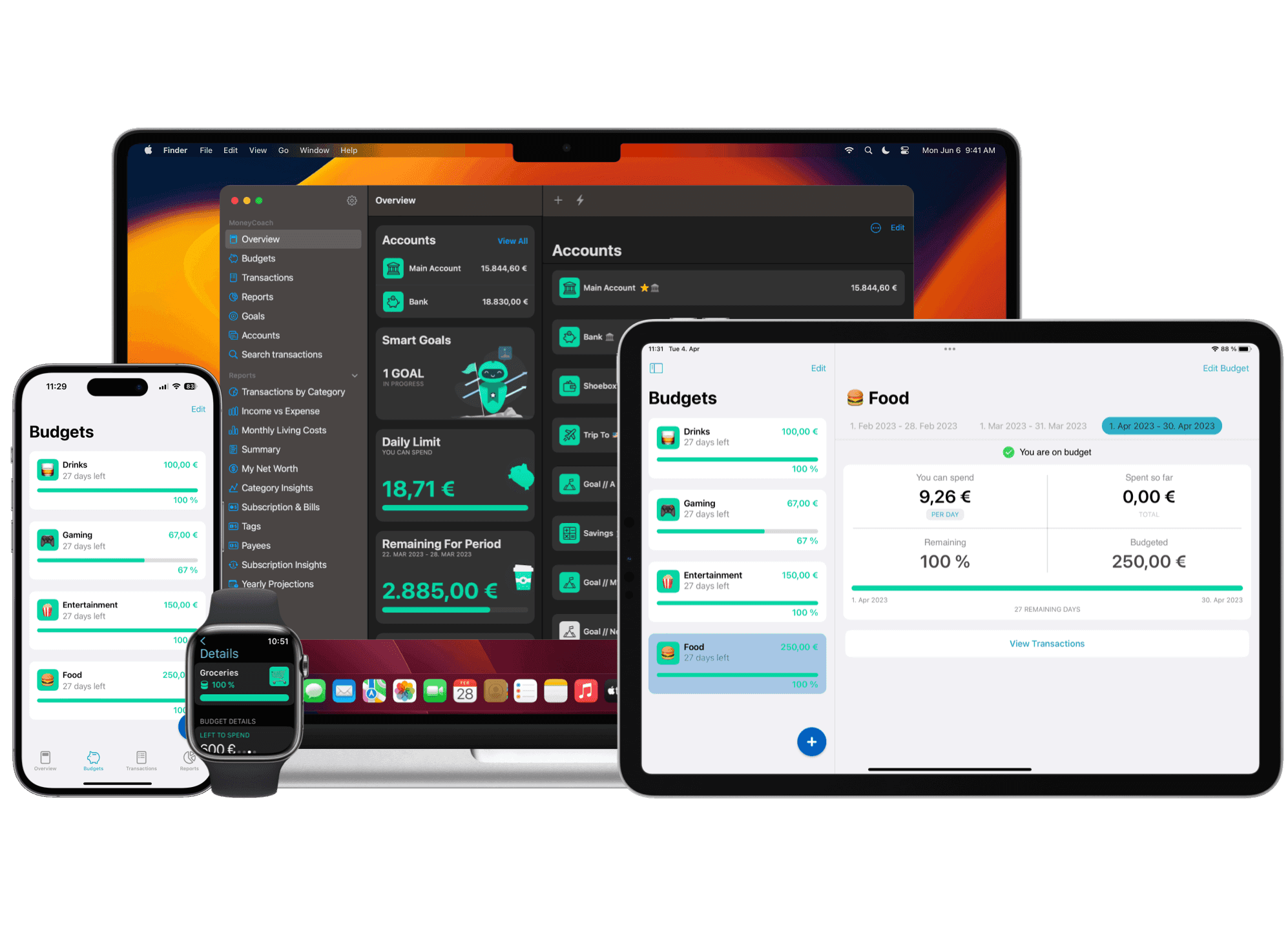
Budget your Apple Card spending in MoneyCoach. Once you have the CSV, MoneyCoach imports it with one tap, categorizes the transactions, and puts them into budgets and reports on iPhone, iPad, Mac, and Apple Watch. See the Apple Card budgeting app page for what happens after the export.
Download a monthly Apple Card statement on iPhone
- Open the Wallet app.
- Tap Apple Card.
- Tap Card Balance.
- Scroll to Statements and choose the month you need.
- Tap Download PDF Statement.
- Use the Share button to save it to Files, print it, email it, or send it to another device.
A PDF is best when you need the statement exactly as issued—for recordkeeping, a reimbursement, a lender, or a discussion with support. It is readable, but it is not the convenient format for budgeting calculations.
Export Apple Card transactions on iPhone
Follow the same path—Wallet > Apple Card > Card Balance—then choose one of these options:
- One statement month: select the statement and tap Export Transactions.
- A custom period: under Statements, tap Export Transactions, choose the start and end dates, then select the available file format.
Save the export to Files if you plan to import it somewhere else. Give the file a clear name such as apple-card-2026-07.csv before downloading another month, so files do not become mixed up.
Download statements on iPad
On iPad, Apple Card starts in Settings rather than Wallet:
- Open Settings.
- Tap Wallet & Apple Pay.
- Tap Apple Card, then Card Balance.
- Choose a statement month.
- Download the PDF or export its transactions.
You can also use the date-range export from the Statements section on iPad.
Download Apple Card statements online
If you do not have your iPhone or iPad nearby:
- Go to card.apple.com and sign in with your Apple Account.
- Click Statements in the sidebar.
- Click the download button beside a month to save its PDF.
For a custom transaction period, click Statements > Export Transactions, select the dates and format, then click Export.
PDF versus CSV: which should you use?
| Your goal | Better choice | Why |
|---|---|---|
| Read or print the official statement | Preserves the statement layout and totals | |
| Check the payment due, interest, or statement balance | Presents the billing-cycle summary clearly | |
| Sort merchants or calculate category totals | CSV | Stores one transaction per row |
| Import transactions into MoneyCoach | CSV | The dedicated importer reads Apple Card transaction data |
| Keep tax or reimbursement evidence | PDF, plus CSV if analysis is needed | PDF is the record; CSV is the working data |
Import the Apple Card CSV into MoneyCoach
After exporting the CSV:
- Save the file to Files, iCloud Drive, or another document provider available on your device.
- In MoneyCoach, open Settings > Import & Export.
- Tap Apple Card: Import, then Select CSV.
- Choose the Apple Card file and review the imported transactions.
The dedicated Apple Card flow avoids manual column mapping. See the illustrated Apple Card import guide if you want the exact MoneyCoach screens.
Import each statement only once. Before confirming a second import, compare its first and last transaction dates with the account in MoneyCoach to avoid duplicates.
What to check on the statement each month
Start with five fields:
- Statement balance: the amount captured when the billing cycle closed.
- Minimum payment due: the smallest required payment; it is not a target payoff amount.
- Payment due date: the date by which the issuer must receive the payment.
- Interest and fees: costs that deserve investigation, especially if you expected to pay in full.
- Transactions and credits: purchases, refunds, payments, and adjustments that should match your records.
Then scan for unfamiliar merchants, duplicate charges, missing refunds, and subscriptions you meant to cancel. If something looks wrong, use Apple Card support from Wallet rather than assuming a budgeting category is the source of truth.
Common problems
The newest statement is missing
A monthly statement is available after its billing cycle closes. For activity in the current open cycle, use the custom date-range transaction export where available or review recent transactions in Wallet.
The file will not import
Confirm that you exported transaction data, not the PDF statement. Keep the original column names and file structure; opening and resaving a CSV in a spreadsheet can change dates, separators, or encodings.
Transactions appear twice
Stop the import and check whether that month or date range was already added. Overlapping custom ranges can also create duplicates, so use non-overlapping start and end dates.
The useful workflow is simple: keep the PDF as your official monthly record, use the CSV for analysis, and review the imported total against the statement before relying on any budget report.