A successful budget does four jobs: it shows what money is available, protects essential bills, prepares for costs that do not happen every month, and directs the remainder toward goals you actually care about.
The eight components are:
- reliable net income;
- fixed essential expenses;
- variable essential expenses;
- true expenses and sinking funds;
- flexible spending;
- savings and debt goals;
- a cash buffer; and
- tracking plus a regular review.
You do not need a complicated spreadsheet or a perfect percentage formula. You need a plan whose totals match reality and a feedback loop that helps you change it.
1. Reliable net income
Budget money you can actually spend, after taxes and payroll deductions—not the gross salary shown in a job offer.
Include predictable sources such as wages, pension, benefits, or stable business income. Treat bonuses, gifts, reimbursements, and speculative income separately until they arrive.
If income varies, start with a conservative baseline: the lowest normal month's take-home pay or an average that excludes exceptional months. Then create priorities for any amount earned above that baseline.
2. Fixed essential expenses
These are necessary bills whose amount is mostly predictable:
- rent or mortgage;
- insurance;
- childcare;
- minimum debt payments;
- phone and internet plans; and
- recurring transport costs.
Record the amount and due date. Fixed does not mean untouchable forever; it means the expense is hard to change within this month's budget.
3. Variable essential expenses
Groceries, electricity, fuel, medicine, and household supplies are necessary but fluctuate. A single ideal month is a weak estimate, so review at least three months of transactions and account for seasons.
Use a realistic category limit, then monitor it during the month. If groceries run high, the useful response is not pretending the purchase never happened—it is deciding which other flexible category will absorb the difference.
4. True expenses and sinking funds
Many “unexpected” costs are predictable but infrequent:
- annual insurance;
- car maintenance;
- school supplies;
- gifts and holidays;
- device replacement;
- professional fees; and
- travel to see family.
Convert each into a monthly amount. A €600 annual insurance bill needs €50 per month. A €900 repair target needed in nine months needs €100 per month.
These allocations are often called sinking funds. They make the monthly budget honest by charging today's income for tomorrow's known costs.
5. Flexible spending
Dining out, entertainment, hobbies, clothing upgrades, and spontaneous purchases belong in the budget too. Excluding them creates a plan that looks disciplined but is difficult to follow.
Set a limit you can spend without guilt once essentials and goals are covered. If the total plan exceeds income, flexible categories are usually easier to adjust than rent, insurance, or medication.
The popular 50/30/20 framework can be a rough starting point—50% for needs, 30% for wants, and 20% for saving or debt—but it is not a pass/fail test. Use the 50/30/20 Budget Calculator to compare those starting targets with your real monthly plan. A household with expensive housing or aggressive debt repayment may need very different percentages.
6. Savings and debt goals
Give each goal an amount, deadline, and priority. “Save more” is hard to execute; “transfer €150 on payday until the emergency fund reaches €3,000” is actionable.
A practical order is:
- cover essential bills and required minimum payments;
- create a starter buffer for small surprises;
- use any employer match or equivalent high-value benefit available to you;
- direct additional money toward priority debt or savings goals; and
- fund longer-term goals based on your circumstances.
There is no universal debt-versus-saving answer. Interest cost, access to cash, job stability, and personal risk all matter. The budget should make the tradeoff visible.
7. A cash buffer
A category budget and an emergency fund solve different problems:
- A category buffer covers normal variation, such as a grocery week that costs €20 more.
- A sinking fund covers a known future expense.
- An emergency fund covers a significant unplanned event, such as lost income or an urgent repair.
Start with a buffer that prevents small errors from causing overdrafts. Build a larger emergency reserve over time according to the stability of your income, obligations, insurance, and household needs.
8. Tracking and review
A budget is a forecast. Tracking tells you what happened; the review tells you what to change.
Use this rhythm:
- Weekly: categorize transactions, check remaining category amounts, and investigate errors.
- On payday: fund bills, goals, and sinking funds before deciding what is available for flexible spending.
- Monthly: compare plan versus actual, roll forward known costs, and adjust category limits.
- After a life change: rebuild the plan when income, housing, debt, or household size changes.
Do not call every variance a failure. Ask whether it was a one-off event, a bad estimate, or a repeated behavior. Each cause needs a different fix.
How long does a new budget take to work?
Expect about three months of deliberate adjustment, not six or seven months of waiting for the budget to fix itself.
- Month 1 — observe: capture transactions and find the costs you forgot.
- Month 2 — correct: replace guesses with real category amounts and add missing non-monthly expenses.
- Month 3 — stabilize: automate repeatable actions, set category buffers, and confirm that total planned spending fits income.
Some households settle faster; irregular income or seasonal bills can take longer. A budget is “working” when it helps you make tradeoffs before the money is gone—not when every category finishes exactly at zero.
Why fine-tuning is worth the effort
The first draft is based on estimates. Fine-tuning converts those estimates into a plan grounded in your actual life. A 15-minute weekly review can reveal a subscription you forgot, an unrealistic grocery limit, or a goal contribution that never leaves the checking account.
Use the budget review worksheet to compare planned and actual amounts. Change one assumption at a time, record why, and check the result next month. That creates a useful history instead of repeatedly starting over.
Example monthly budget
Suppose take-home income is €3,000:
| Component | Planned amount |
|---|---|
| Fixed essentials | €1,350 |
| Variable essentials | €500 |
| True expenses and sinking funds | €250 |
| Flexible spending | €350 |
| Savings and additional debt payments | €400 |
| Cash buffer | €150 |
| Total | €3,000 |
If variable essentials reach €550, the plan needs a €50 decision. You might use part of the cash buffer, reduce flexible spending, or revise next month's estimate. What you should not do is leave the budget total at €3,050 against €3,000 of income.
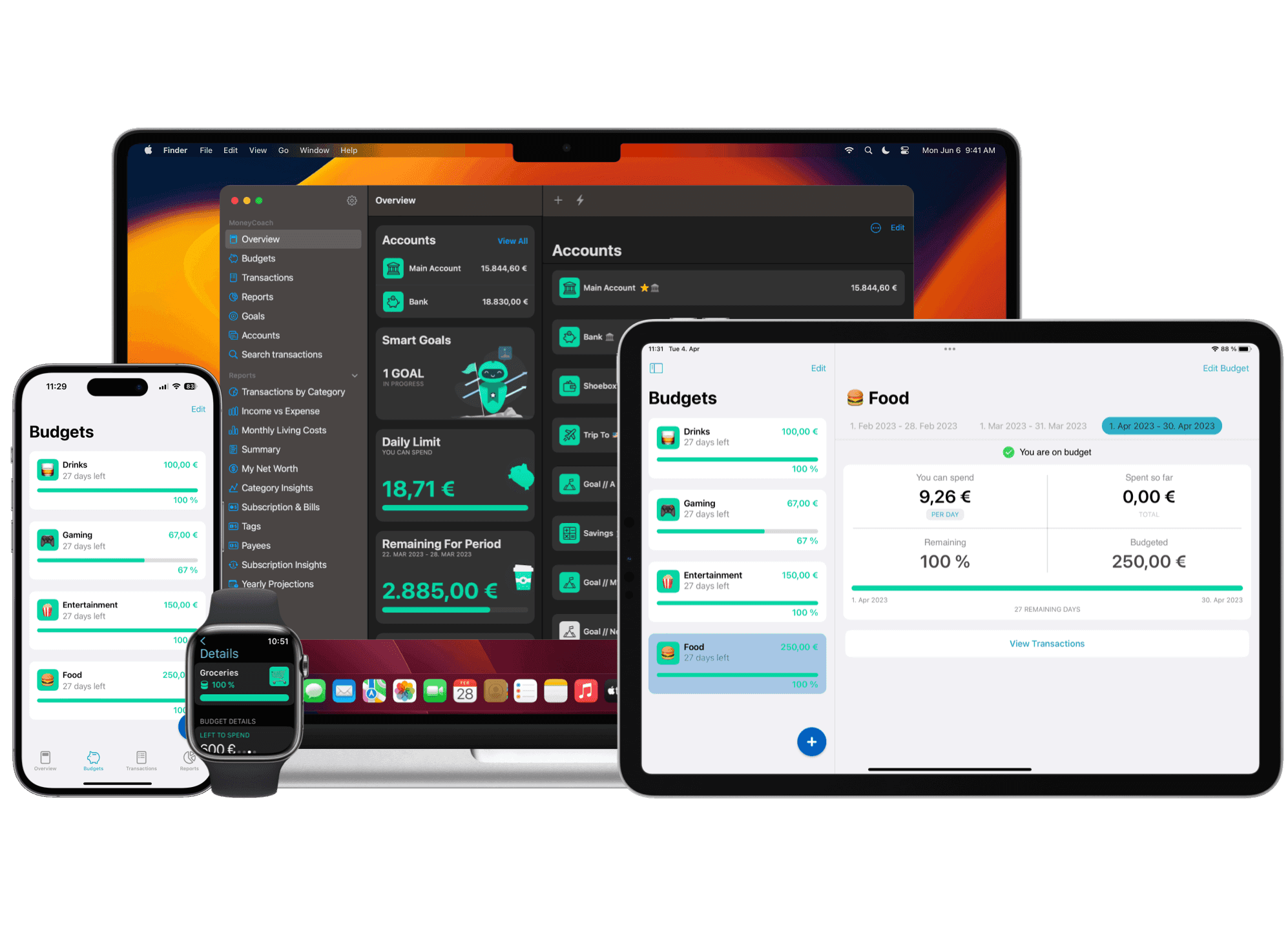
Build the budget in MoneyCoach
- Add accounts and a reliable opening balance.
- Record income and repeating bills.
- Create categories that match the decisions you make—not dozens you will never review.
- Set category budgets for variable essentials and flexible spending.
- Create goals or separate allocations for sinking funds.
- Review actual spending before the next month begins.
The getting-started budget guide covers the first setup. When you are ready for per-category controls, use the category budget guide.
Common budgeting mistakes
- Using gross income: it allocates money that never reaches the account.
- Forgetting annual costs: the budget appears to work until a predictable bill arrives.
- Making categories unrealistically low: repeated overspending may be an estimation problem.
- Tracking without deciding: a list of past transactions is not yet a plan.
- Copying someone else's percentages: their costs and priorities are not yours.
- Starting over after one bad month: keep the data and correct the next decision.
A strong budget is not the strictest budget. It is the one that covers reality, gives future expenses a place, and makes the next tradeoff easier to see.